
I’m sure there are family stories one remembers being told as a child. Everyone who has ever worked on their tree will have wished they had asked older members of the family for their memories. Sometimes, though, we remember something we were told and in later years when we are delving into our own genealogy it comes to mind.
About half a century ago, my maternal Grandmother related two such snippets of information to me which I clearly remember. She said that one member of our family had been found floating face down in the canal and that another had fled the country after being involved in a money scandal. As a 10 year old this was interesting but not enough to provoke a flurry of questions from me, sadly.
In later years while researching my grandmother’s tree, I quite easily discovered who the poor victim of the drowning was; her Uncle Henry (Harry), who was her father’s brother. His probate record – National Probate Calendar (Index of Wills and 1858-1995) helpfully gives his place of death as the River Lea, Bromley by Bow on 17 June 1924. I have not been able to locate a coroner’s report or newspaper article that may have given more information, but there is always more work to be done.
Without any other clues, I could not find where the money scandal story came from. At least for several years. I was researching another of my Grandmother’s uncles, Charles Frederick Burden and building up a picture of his life. He was born in 1858, the son of a Customs Officer in Gravesend, Kent, an occupation he appears to initially follow as it is given on his marriage to Sophia Baker On 13th October 1876, at Christ Church, Watney Street St George in the East. He is listed as a bricklayer in the 1881 Census and a surveyor in the 1891 Census. For a while I lost trace of him as he disappeared from the England and Wales 1901 Census. His wife Sophia, whilst shown to be married on the 1901 census was living without him and with their five surviving children in Clapton, London.
He did, however, show up in the 1901 Census of Canada. He was now a lodger in Massey Ontario and still gives his occupation as a surveyor. Could he be the relative that fled abroad? I would need to know a lot more about him before making any assumptions.
Reading newspaper content accessed, through the British Newspaper Archive, it became apparent that having learned about the building industry as a bricklayer, Charles Burden later worked as a surveyor and had risen to the position of Superintendent of Works at Mile End Workhouse around 1884 and was appointed the Architect for the Guardians of the Poor in 1894. He was responsible for assessing tenders for work and for the design of buildings of the Union Workhouse and was a member of the Board of Guardians. The committee met twice a week and their business was reported in the local newspapers so a picture of Charles Burden’s involvement in the running of the workhouse was quite easy to trace.
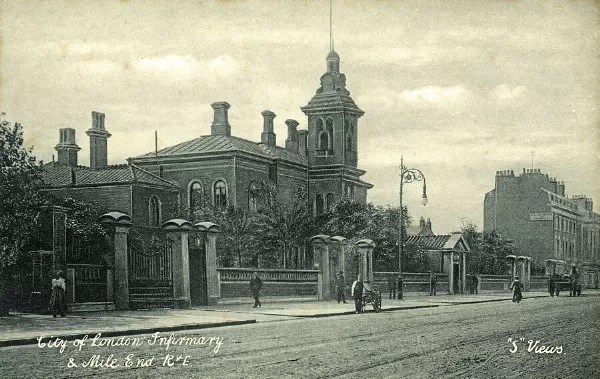
There was, in fact, a large financial scandal which related to the large payments made by the Board the Guardians to tradesmen and contractors. There were alleged instances of bribes being taken and, at trial, all those involved were found guilty of conspiracy and corruptly receiving gifts. However, this was in 1907 and some years after Charles Burden had arrived in Canada so he could not have been involved.
The Minutes of the meetings of the Board of Guardians are preserved and archived at the London Metropolitan Archives (STBG/ME1) and are a fascinating insight into the workings of the committee. The minutes cover much detail from all aspects of the Guardians work so I worked by using newspaper references to Charles first and then looking at the detail in the corresponding minutes. There was no trace of a scandal among all the work he had been involved in. There was a great deal of achievement. He was involved in the design of workhouse buildings, including a modern new laundry which was opened in April 1896 with a ceremony to which many guests including Sophia Burden were invited and which was followed with a ‘light repast’. Later that year he had prepared plans for new cottage homes for children at North Weald, although costs of the project prevented the complex ever being built. In 1897 he oversaw the installation of electric lighting in the workhouse.
Then, suddenly, the Eastern Post Newspaper of February 25th 1899, brings news of Charles Burden’s sudden resignation. Tributes to his work and achievements and his general likeable manner pour out from every line although there is mystery around the circumstances. “As no good purpose would be served by detailing the incidents which have culminated in taking this step….” and “ whilst we cannot but admit, after all the circumstances of the case, the course which Mr Burden has taken in resigning his position is the right and proper one, we do feel on the other hand that his resignation is a distinct loss to the Guardians and the rate payers of Mile End.”
Clearly something had happened and this needed to be further investigated, so having pinpointed the date of the mystery it was back to the archives and the Minutes of the Meeting where his resignation is accepted.
There it was. Not a financial scandal after all. It was a sex scandal.
One morning the young girl from the workhouse went early to light the fire in Mr Burden’s office and what she saw caused her to run screaming from the building. She was shocked to find him on the floor with two ladies, who had clearly been there all night. Upon investigation the night watchman said that the women had arrived in carriages separately and that he had personally shown one of them to Mr Burden’s office late at night. Another employee at the workhouse intimated it was not the first time women had visited his office and that he had been strangely missing from the site on a few occasions when he was needed.
Charles tendered his resignation immediately. We cannot know what the repercussions were for his family but in July the following year he arrived on the Tunisian in Quebec and as we know was living in Massey in by 1901. He left behind his wife Sophia with five teenage children. Meanwhile in Massey he continued work as an architect designing and building the Methodist Church there 1912-1913. Between 1900 and 1911 he also designed the Roman Catholic Mission Church at Cutler, the Methodist church and the Public School at Webbwood and a bank and office block at Massey.
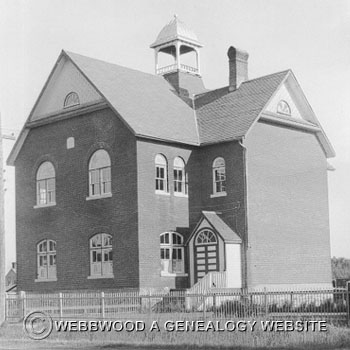
Photo from the Webbwood Genealogy Website. The Webbwood Public School
Sophia died in London in 1931 and Charles died in Massey in 1935. In his obituary in the Sault Star newspaper on 19th November, he is referred to as “a grand old man, liked by all and well known in Massey and surrounding district.” Fred Hallet was the informant. Charles had lodged with him and his family for several years.
Whether my grandmother was being discreet when she told me about the ‘scandal over money’ or she never knew the real reason behind Charles’ hurried exit from England, I cannot know. My late mother said that, in family conversations Sophia was often referred to as ‘poor aunt Sophie’ although she never knew why. Before she died, I was able to enlighten her.
 GIN and GENEALOGY